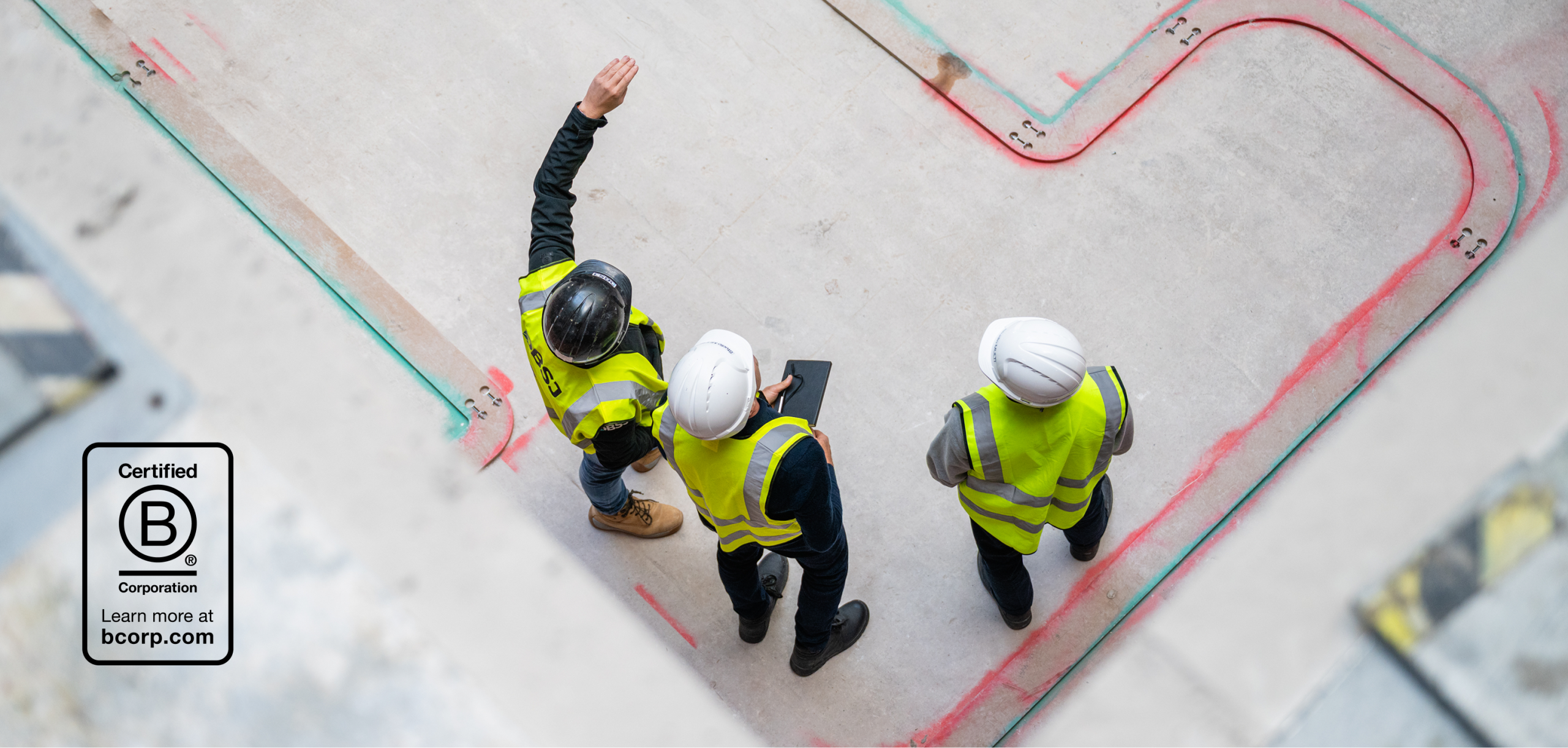
Our B Corp™ Certification marks an important milestone for the business, recognising the progress made in recent years while strengthening accountability for how DBSJ operates and grows.
“B Corp Certification adds to a period of significant progress for DBSJ. From winning major industry awards to investing substantially in our ESG commitments, we have worked hard to build a stronger, more responsible business.
Darren Hill, CEO at DBSJ
I am incredibly proud that achieving B Corp Certification recognises the progress we have made in a relatively short period of time. More importantly, it strengthens our accountability and gives us a shared framework for responsible growth.
I know I speak for our leadership team, and the wider business, when I say that we are passionate about continuing to improve how we support our people, serve our clients and partners, contribute to our communities and reduce our environmental impact.
While we are immensely proud to have achieved B Corp Certification, we do not see it as the end of a journey or a claim that we have solved every environmental and social challenge associated with our industry.”
While we are immensely proud to have achieved B Corp Certification, we do not see it as the end of a journey or a claim that we have solved every environmental and social challenge associated with our industry.
Design, build, shopfit and joinery have real impacts. Materials must be produced and transported. Projects consume resources. Construction creates waste. There will always be difficult decisions involving performance, cost, availability, programme and environmental considerations.
Responsible business means acknowledging those realities and continually looking for better answers.
What does it mean to be a B Corp™ Certified company?
Certified B Corporations™, or B Corps™, are companies verified as meeting standards for social and environmental performance, transparency and accountability.
To becoming a Certified B Corporation™ means being independently assessed against B Lab’s rigorous standards for social, environmental and governance performance, transparency and accountability. It looks at the business as a whole, examining not simply what a company says it stands for, but how responsibly it operates and the impact its decisions have on people and the planet.
The certification process considers areas including how a business is governed, how it supports its people, climate action, human rights, environmental stewardship and circularity, and the wider role it plays within society. Importantly, certification is not a one-off achievement. B Corp™ is built around accountability and continuous improvement, providing a framework that challenges businesses to keep measuring their impact, raising their ambitions and finding better ways to operate.
For us, that is what makes becoming a B Corp particularly meaningful. It recognises progress already made, while creating an even stronger framework for the progress still to come.
What does this mean for our clients?
For clients, responsible business must translate into practical action. Our objective is to ensure that environmental, social and governance considerations increasingly become part of the way a project is planned and delivered, rather than something considered separately from it. That means looking closely at where materials come from, how suppliers operate, how efficiently resources are used, what happens to waste, how people are supported and protected and how performance is monitored and reported.
Ultimately, it is about helping our clients deliver exceptional interiors while making better-informed decisions about their wider impact. We are passionate about meeting the challenges of continuing to improve how we support our people, serve our clients and partners, contribute to our communities and reduce our environmental impact.
For DBSJ, certification is not simply something to communicate. It strengthens an approach to responsible business that increasingly influences how we procure, design, manufacture, manage our supply chain and deliver projects.
The principle of continuous improvement sits naturally alongside DBSJ’s existing management systems, including our ISO 14001 Environmental Management System, our ISO 9001 Quality Management System and our established health and safety processes.

B Corp™: Danielle Bennett, our ESG Manager, explains why B Corp Certification has been a priority initiative for DBSJ.

Responsible procurement and supply chain
A significant proportion of the impact of any fit out sits within its materials and supply chain. Our approach is therefore to integrate responsible procurement requirements into project planning, subcontract agreements and supplier selection from the outset.
We seek to work with suppliers and subcontractors that share our values, have appropriate policies and certifications in place and are willing to engage positively with the environmental and social objectives established for a project. Our existing responsibility framework already places strong emphasis on the relationships we build with our supply chain partners. This includes:
- Integrating relevant project and business requirements into subcontracts
- Establishing clear and standardised goals against which supply-chain performance can be assessed
- Providing suppliers with support to help them meet project requirements
- Giving preference, where appropriate, to responsibly sourced, ethical and independently certified products
- Considering procurement decisions from a whole-life cost and performance perspective
- Working collaboratively with our supply chain to identify new solutions and share best practice
Materials delivered for installation are checked by the project Sustainability Advisor against the aims, objectives and targets established for the project. Material information and relevant sustainability credentials can then be recorded within the project materials database, creating greater visibility of what has been specified and installed and supporting compliance with agreed procurement targets.
The result is a more transparent approach to procurement and a clearer evidence trail for clients with their own sustainability, ESG or reporting requirements.

Making more considered material choices
Through DBSJ’s integrated design, build and joinery capabilities, we have opportunities to influence material choices at several stages of the project lifecycle.
Our in-house joinery operation uses legally and sustainably sourced timber, while our finishing processes prioritise indoor air quality through measures such as using water-based lacquer wherever feasible. Across projects, our teams can also explore responsibly sourced materials and products with recognised environmental credentials. But responsible specification goes beyond selecting a product carrying a particular label.
We increasingly look at durability, maintainability, expected lifespan, embodied impact, opportunities for reuse and what may ultimately happen to a material at the end of its useful life.
For clients, this can help balance environmental objectives with the realities of performance, programme, aesthetics and budget, creating interiors designed to deliver long-term value rather than focusing only on initial cost.
Material information and relevant sustainability credentials can then be recorded within the project materials database, creating greater visibility of what has been specified and installed and supporting compliance with agreed procurement targets.
The result is a more transparent approach to procurement and a clearer evidence trail for clients with their own sustainability, ESG or reporting requirements.